Things that surprised me in China as an experienced traveller
Initially, this was meant to be about Japan. But when my husband failed to get his Japanese visa back in time for our departure, our plans changed.
We went to China instead. We booked our tickets for a flight a month later. And despite the short time and lack of preparation to make it a successful trip, it was one of the best time we’ve had.
Here are things that completely took me aback, blew me away and made me leave China with a new state of mind about the country.
SMOKING IS ALLOWED INDOORS.. iN FACT, IT’S ALLOWED PRETTY MUCH EVERYWHERE
We landed in Guanzhou (Canton) and upon arriving in the arrivals terminal, I quickly noticed the smell of cigarette. Looking around, I can see people smoking within the airport and no one to tell them off.
In China, it is legal to smoke indoors, something that seems completely impossible for people born after 2000. Having grown up in the 90s, I did remember people smoking indoors long ago before it was banned in the West. Officially, China prohibits smoking indoors. In reality, this law is mostly applied in Beijing and Shanghai. Elsewhere, people can smoke in train stations, shops, hotels, restaurants, even in an enclosed space like a lift. Some places put up a prohibited sign but that will not always be respected by the locals. At one of the hotels, our room was supposed to be on a non-smoking floor, though pillar ashtrays were beside every door in the corridor.
tECHnology IS LIFE
You cannot live in China if you do not have some essential apps. There is one app in particular that allows you to do pretty much anything you want: WeChat.
Want to book a foot massage? WeChat. Need to rent a flat? WeChat. Need a hospital appointment? WeChat. Pay for your morning coffee? WeChat. Want to book an attraction? WeChat. Hotel? WeChat.
You got it, WeChat can do almost everything.
If you want to pay for any purchase, two paying apps are available: AliPay and…. WeChat. You will need to have a certain amount of Chinese-built apps in order to travel to and around China
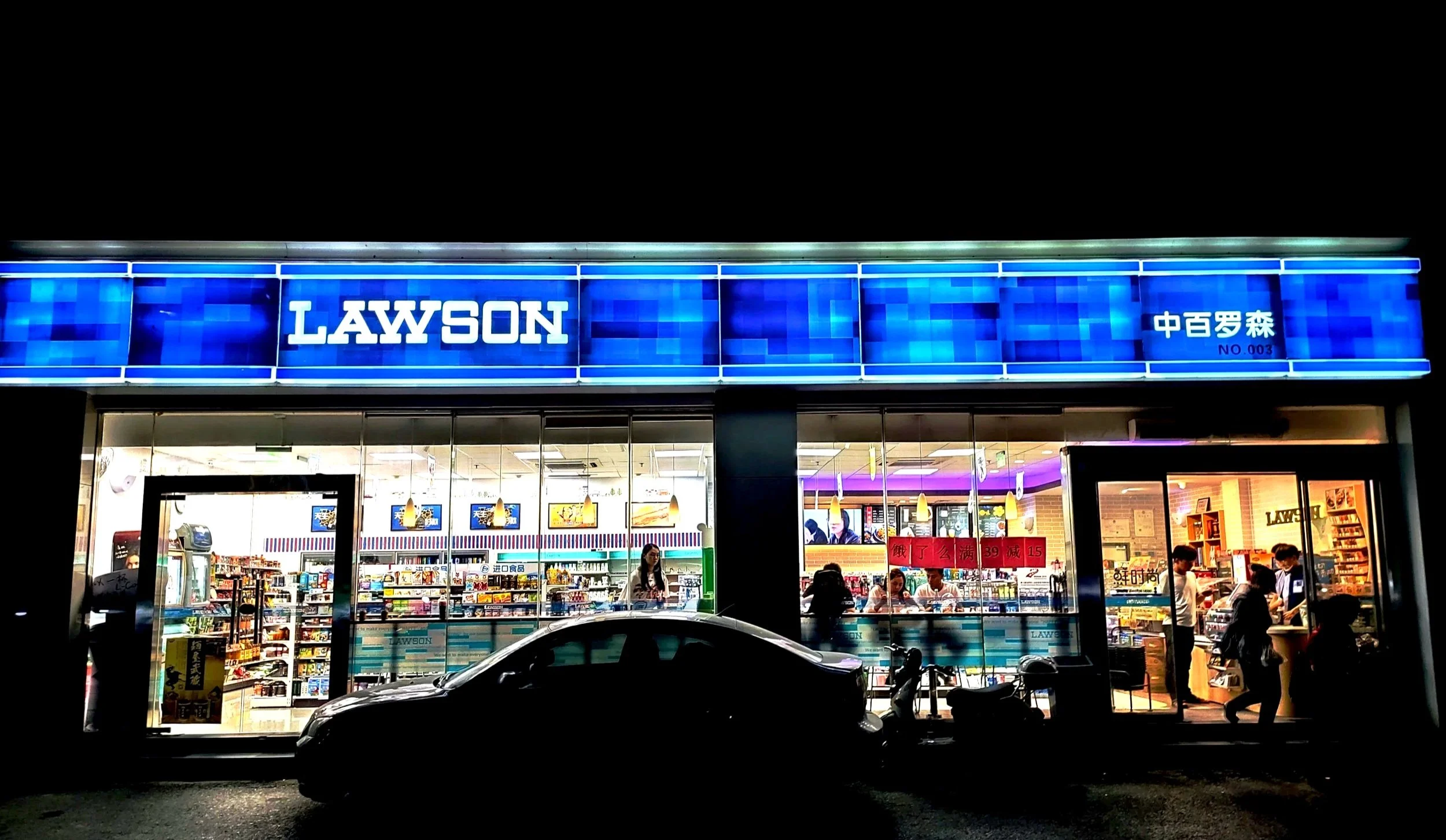
Any time of the day or night, the convenient store is always open.
Convenience is convenient
One of the things that surprised me the most in China was how convenient and efficient things were. Below are just a few examples of what Chinese people do to make their lives easier:
Of course, you have the convenient stores: 7-eleven, Family Mart and Lawson. They are open 24/7 and you will find snacks, drinks, toiletries and all necessary bits at any time of the day or night (if you suffer from heavy jetlag like me and need food at 3am, they are a life-saver). Asian mart at its finest which you should experience.
Food deliveries are taken to the next level. In front of most offices and residential buildings, you will find small lockers with a window which is where the delivery drivers will leave any food and drinks delivery to be picked up by the person who ordered. In China, you can also have food or drinks be delivered directly to you pretty much anywhere. Say you are having a meal in a restaurant and want to have a large bubble tea from Chagee (tea shop chain), you can have it delivered to you…directly to your table. We have seen people getting all sorts of things delivered to them on the streets, in shopping centres, to their hotel bedroom door and inside restaurants, of course. Including umbrellas for young girls who were caught in the heavy rain.
Chinese restaurants will provide disposable gloves and wipes for any food to be eaten with your hands. Hygiene is sacred and every place we ate at was spotless clean. We found this to be actually very handy so you don’t have to rush to your hand sanitiser or wipe your hands off grease on a napkin that doesn’t do much to clean anyway.
Their version of Uber will come pick you up from where you are without having to walk miles to find them and drop you in front of your destination and car parks all have free electric charging.
Your phone has only 12% battery? Don’t worry, there are thousands of power bank stations EVERYWHERE. Even in the most unlikely places, you will find one. No longer need to carry your own, desperately find a plug in a coffee shop or rush back to the hotel for juice. For just a few yuans per hour, power banks can be rented for any period of time and returned anywhere in the country for as long as it’s returned to the same provider’s charging station as they are several across the country. It is nearly impossible in China to step outside your home without needing your phone at some point whether it is to pay, shop, visit, order or even go to the hospital. Therefore it is essential to have power bank stations available to recharge. Though this was a service only Chinese ID holders could access.
Everything is made to be convenient and simpler on a daily basis. Of course, they are some downsides, like single use plastic. Being a non-resident can also prevent you from enjoying this new found convenience. We were not able to get anything delivered or even rent a bicycle as we did not possess a Chinese ID which was a mandatory feature to add to the delivery order.
fOOD WAS UNEXPECTED
I have eaten a great deal of foreign food while travelling but I have to say that Chinese food is amongst the best I have had. And the bonus is that it has nothing to do with what we can find in the West.
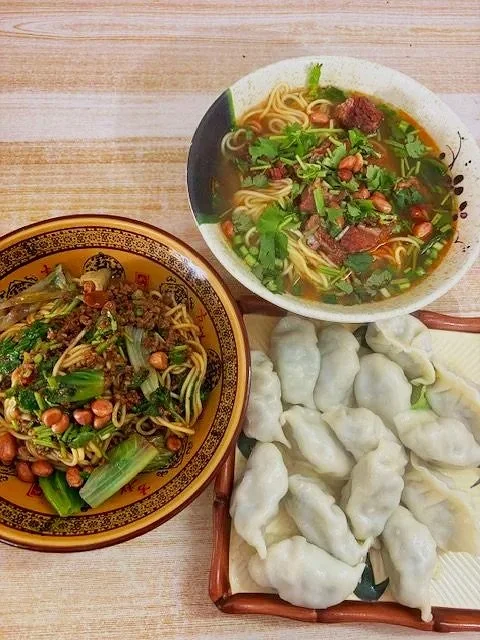
The variety of dishes is wide and almost limitless. From dumplings to noddles, to pancakes, drinks with many different flavours, colourful street food items and sweets. Even the local convenience store is a thing to behold when it comes to snacks. Countless combinations and possibilities that it becomes overwhelming.
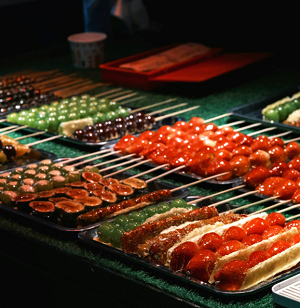
My most favourite dishes were Peking duck with pancakes, soy meat noodles, pork and chives dumplings, Mixue’s strawberry yoghurt drink, Tanghulu laid out like glistening gems (skewers of fresh fruits, often strawberries, coated in glass thin sugar) and 7-eleven’s Chinese rendition of a corn dog.
Eating out is surprisingly cheap as it is considered a daily food option. A meal for two people in a local shop will set you back less than £5 (€5.80 / $6.80 as of 2025).
tRAINS are top tier
Travelling by train is by far the best method of transportation. China has 50,000 kms (31,000 miles) of operational high speed rail with a further 20,000 under construction. Their speed can go into the 400km/h (268m/h) and takes about four hours to go from Xi’an to Beijing, separated by about 1,000kms (621 miles).
Except for some rare instance where you might come across a non high-speed train, the trains are very comfortable and are separated by class. But even in the economy class, the space and comfort is well above what we get in the West. There are also attendants in every carriage who help you with finding your seat and putting your luggage in the overhead storage place (which they are very strict about, not a strap was to be out of place).
Train stations in China are IMMENSE. Most of the ones we’ve been to in the cities we visited were comparable in size to Luton Airport. You can find in there everything to eat and drink, seats and shops. Be aware that security is very strict and expect to show your passport several times before passing yourself and your luggage through airport-style security and be ready to queue up there for a short while.
We did not realise that and missed our first train to Nanning because we came to the station with 10 minutes to spare not realising we would have to go through heavy security and cross the equivalent of a small airport by foot.
Once you pass security, you’ll need to go to your gate number (yes, like in an airport) and wait by the barrier. As a foreigner, we couldn’t use the e-gates designed for Chinese ID holders and had to show our passports to an agent. Your passport will be scanned as your ticket is linked to it. Tickets have to be booked through WeChat, of course.
Announcements are not always made or displayed in English. We used the WeChat translator to get the correct information and once at the gate, observed when people were getting ready for boarding.
Look out FOR THE PAPARAZZIS
This was not necessarily the most pleasant of experiences but the reality is it really can’t be helped.
Obviously, we did not really physically blend with the locals, and as a mixed raced couple, I guess it did not really help us be as inconspicuous as we would have wanted. So naturally, we should have expected people to take pictures of us whenever and wherever we went.
I am not a naturally happy picture poser or a very relaxed one but there was not much we could do about it. People did try to be discreet about it but when they come to you while you are slurping up a bowl of noodles and snap a shot in front of your face, it cannot be ignored.
We’ve had several requests for selfies and were always very happy to take one with whomever asked respectfully. A noodle shop owner who couldn’t believe that a Sri Lankan man and French/British woman travelled together requested to take a picture with him to show his grand-daughter which we agreed to. In most times, we knew that it came from a place of curiosity and people genuinely seemed happy to see and take a picture with us.
iT IS A VERY BIG PLACE
There is one thing I did not realise before going to China: how big the country is. How wide the distance between two places is. I underestimated how spacious their cities are. Unlike much of Europeans cities, Chinese cities are not walkable in the least and going from one point to another can easily take you several hours. Transportation is very reliable and easy to use, however taxis remains the best option to go around. They are cheap and efficient but depending on the time of day, traffic will surely impact your schedule. Preparation is key and given we had only one month to prepare a three and half weeks trip, this is something that we completely forgot to include in our plans.
The other thing that comes with a very big place is the number of people. China is home to 1.4 billion people. It also has a very developed domestic tourism industry. Most places we visited had a large number of Chinese tourists and very few foreign visitors. To try an avoid the mass of visitors, we woke up early or tried to take the least visited area/gate to enter. Chinese tourists mostly travel in tour groups with tour guides talking to them in mikes through speakers and after experiencing this once, we kept to the least busy places for the rest of our trip. It required some research and preparation while we were there and some change of plans.
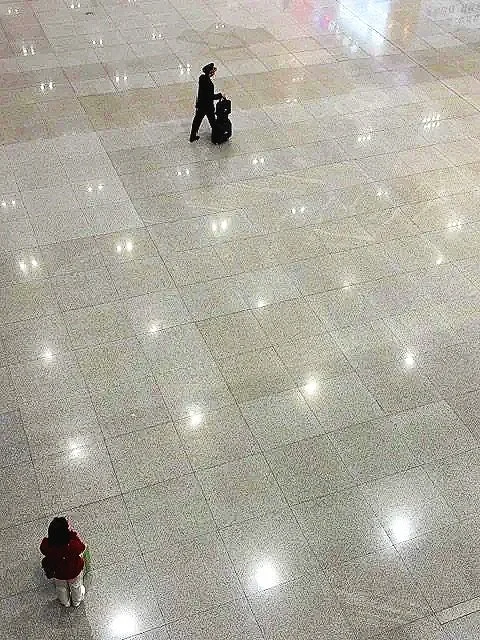
This was just a very small corner of the train station. And even conductors are dressed like pilots.
Safe and secure
China is known for its many cameras and even though, as a Westerner, I could have felt some sort of scrutiny, it was the complete opposite. Yes, there are a VERY LARGE number of cameras but they are dissimulated so very well that I did not even think about them most of the time. In fact, not only I barely noticed them but I felt extremely safe everywhere.
Not once did I feel insecure during the day or at night. Whether in a big city or in the countryside, we walked around at night without being bothered or feeling any danger coming our way.
The level of security is high enough for everyone to feel safe pretty much everywhere. We even found cameras at the top of a mountain in Zhiangjiajie.
They are in the future
It truly is remarkable how far advanced China is.
Most of their technology is very far ahead. Nearly all cars are 100% electric and they have adapted their infrastructures to make it easier to charge anywhere.
We have witnessed waiter-robots doing housekeeping in hotels (perhaps I should say maid-robots), drones delivering food or groceries.
Access to most attractions requires your passport only, onto which your tickets are linked. In some cases, we did not even need to scan our passport but just stood still at the turnstile and looked at the camera which would use facial recognition to find your passport and then your ticket in the database to finally let you through.
Even though cash is still very present (Chinese Yuan or RMB is the currency), the main method of payment remains scanning a QR code directly linked to your WeChat on which you can either link your bank card or deposit money in your WeChat account. Even the modest dumpling shop will have a WeChat or AliPay QR code.
China was never the original plan, but it turned out to be such a revelation. From the food and technology to the scale and efficiency of daily life, the country constantly blew our expectations. I left with a completely new perspective on China and I already want to go back.
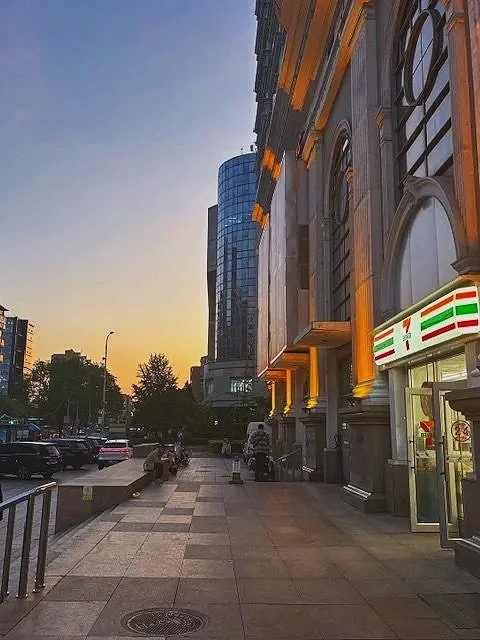
7-eleven at nightfall, Beijing.
